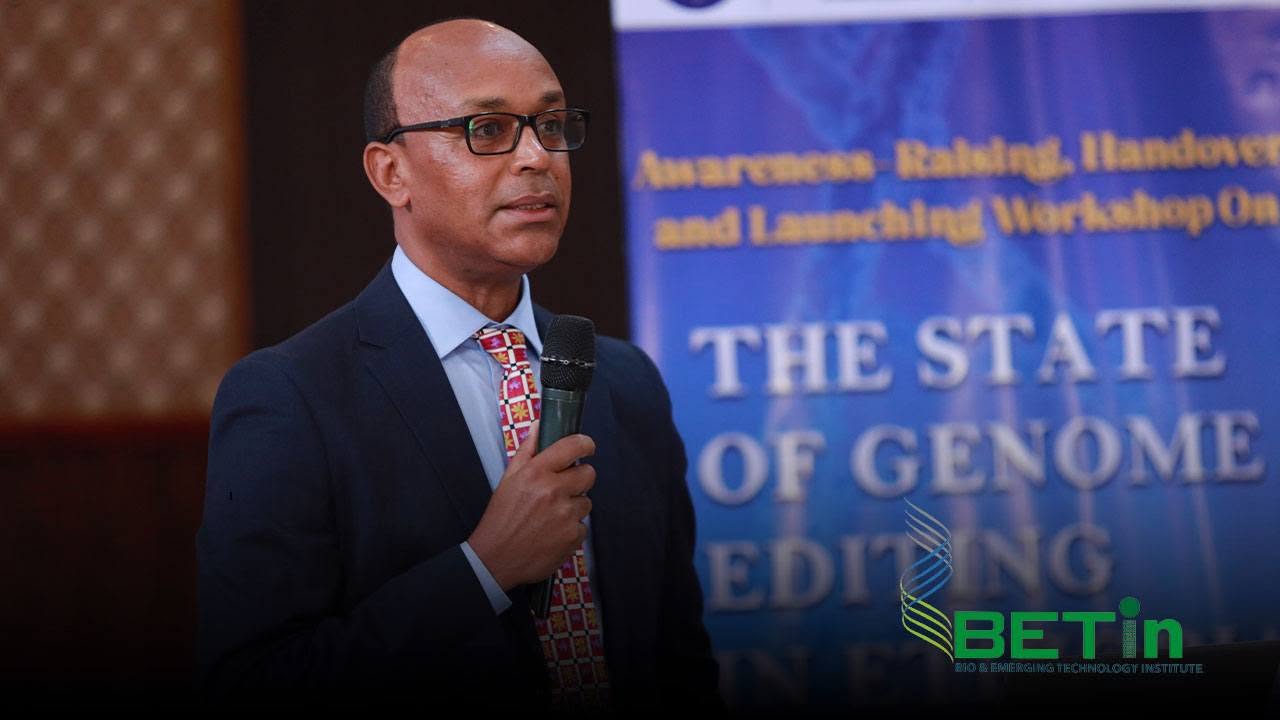
The Bio and Emerging Technology Institute (BETin) successfully hosted an Awareness-Raising, Handover, and Launch Workshop on March 23–24, 2026, at Haile Resort, Hawassa. The event focused on two landmark national documents: “The State of Genome Editing in Ethiopia” and “Ethiopia’s Readiness for Establishing a National Bio-Innovation Hub.”
The workshop brought together senior government officials, researchers, academia, and development partners, creating a strong platform to strengthen collaboration and advance Ethiopia’s biotechnology and bio-innovation agenda.
The program commenced with welcome remarks from the Sidama Science and Technology Agency, delivered by H.E. Mr. Tefera Barasa, Director General, who emphasized the importance of strengthening regional and national collaboration in science, technology, and innovation.
In his official opening speech, H.E. Prof. Kassahun Tesfaye, Director General of BETin, highlighted the strategic importance of genome editing and bio-innovation in driving Ethiopia’s socio-economic development. He underscored their role in improving agricultural productivity, strengthening health systems, and enhancing environmental sustainability. He further stressed the critical contribution of research institutions and universities in knowledge generation, technology transfer, and innovation, calling for stronger collaboration among academia, government, and industry to accelerate the establishment of a functional National Bio-Innovation Hub. He also expressed his sincere appreciation to the Program for Biosafety Systems (PBS), managed by the International Food Policy Research Institute (IFPRI), for providing both technical and financial support in the development of these strategic documents.
The keynote address by Dr. Zerihun Demrew, Dean of the College of Agriculture at Hawassa University, reinforced the importance of research and innovation in advancing Ethiopia’s biotechnology sector.
He highlighted the need for strong institutional linkages, sustained investment in research infrastructure, and the development of skilled human resources to fully harness emerging technologies in biosciences.
Technical presentations by Prof. Firew Mekbib and Prof. Teklehaimanot Haileselassie provided key insights into the two national documents, outlining major findings, policy directions, and strategic recommendations.
A major milestone of the event was the formal handover of the two documents to key stakeholders, including regional representatives, ministries, regulatory authorities, universities, and media. This marked a significant step toward strengthening Ethiopia’s biotechnology ecosystem and advancing the establishment of a National Bio-Innovation Hub.
Following the handover, Dr. Allo Aman, Senior Researcher at BETin, presented the proposed implementation roadmap and institutional framework.
Way Forward
Participants agreed on the establishment of two key implementation structures:
High-Level Steering Committee – A senior-level body drawn from relevant national institutions and the private sector to provide strategic direction and oversight for the implementation of both documents.
Technical Working Team – A multidisciplinary technical team drawn from relevant national institutions and the private sector to coordinate and execute the activities outlined in the documents.
Stakeholders also emphasized the importance of: Strengthening partnerships
Mobilizing resources Enhancing capacity-building efforts.
These collective efforts are expected to play a critical role in advancing genome editing to address key national challenges across sectors, while ensuring the effective implementation of the recommendations and the successful establishment of the National Bio-Innovation Hub.